
General
The Evolution of Automotive Intelligence
Editorial Team · Published 2026-10-31 · Updated 2026-11-08
Evolution from Assembly Lines to Software-Defined Vehicles era of design.
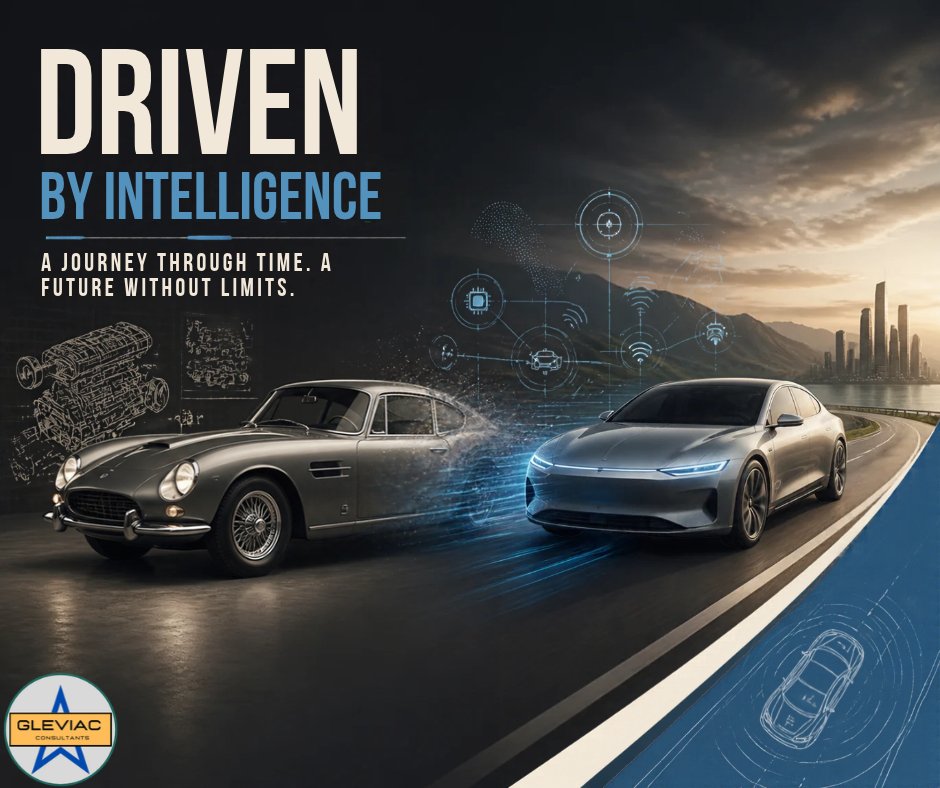
The modern automobile is no longer defined by the mechanical complexity of its internal combustion engine, but by the lines of code running its systems. We are living in the era of the Software-Defined Vehicle (SDV)—a paradigm shift where software dictates the capability, safety, value, and overall driving experience of modern transportation. To fully appreciate this transformation, we must trace its technical provenance, examining how two centuries of mechanical refinement laid the foundations for today’s intelligent, interconnected, and artificial intelligence-driven mobility ecosystems.
Phase 1: The Mechanical Genesis (1769–1888)
The foundation of self-propelled transport began long before the injection of digital logic, rooted entirely in thermodynamic and mechanical innovation:
1769 – The Steam Precursor: French military engineer Nicolas-Joseph Cugnot engineered the first self-propelled steam tractor. Designed strictly for hauling heavy artillery, this heavy three-wheeled platform proved that human mobility could be decoupled from animal labor. The remaining original physical asset is preserved at the Musée des Arts et Métiers in Paris.
1886 – The Gasoline Breakthrough: The recognized birth of the modern automobile occurred when Karl Benz secured German Patent No. 37435 for his gas-fueled Benz Patent Motorwagen. Concurrently, Gottlieb Daimler and Wilhelm Maybach integrated internal combustion engines into four-wheeled carriages. The official legal and technical lineage of this moment remains verified by the German Patent and Trade Mark Office (DPMA).
1888 – Operational Validation: Bertha Benz executed the first long-distance automotive drive (106 kilometers), demonstrating the reliability and mass market viability of her husband's invention. This historical timeline is actively curated by the Mercedes-Benz Classic Archive.
Phase 2: Industrial Standardization and Mass Production (1908–1959)
As the mechanical viability of the automobile crystallized, the industry transitioned from bespoke, artisanal craftsmanship to scalable, repeatable manufacturing architectures:
1908–1913 – The Scaled Assembly: Henry Ford introduced the Model T in 1908, but the true revolution arrived in 1913 with the implementation of the moving assembly line. By dividing production into discrete, repeatable steps, Ford reduced chassis build times from 12 hours to 93 minutes. This optimization drove down prices, democratized vehicle ownership, and established the baseline for automotive enterprise resource planning (ERP). These industrial frameworks are preserved within the Library of Congress Automotive History Collection and The Ford Heritage Vault.
1959 – The Hardware Safety Baseline: As speeds increased, passive safety became paramount. Volvo engineer Nils Bohlin developed the three-point seat belt. Recognizing its industry-wide life-saving potential, Volvo left the patent open for all manufacturers to adopt freely. The engineering specifications reside within the Volvo Cars Heritage Registry, marking the industry's first collaborative safety standard.
Phase 3: The Electronic Transition and Powertrain Efficiency (1970–1997)
The late 20th century forced the automotive sector to contend with emission standards, fuel crises, and the limits of purely mechanical control systems. This friction birthed the first wave of automotive electronics:
The Microcontroller Injection: The introduction of Electronic Control Units (ECUs) revolutionized vehicle management. Mechanical distributors and carburetors yielded to electronic fuel injection and computerized engine timing. Suddenly, hardware optimization required a layer of primitive software code.
1997 – The Hybrid Paradigm: The global launch of the mass-produced Toyota Prius combined internal combustion engines with electric propulsion via an intelligent power split device. Sourced from the Toyota Global Newsroom Archives, this milestone forced the industry to view the powertrain not as a isolated block of iron, but as an integrated, software-managed energy network.
Phase 4: The Modern SDV and AI Frontier (21st Century)
Today, the automotive landscape is experiencing a total digital conversion. Silicon, sensors, and lithium-ion chemistry have displaced traditional mechanical competitive advantages. This modern shift is anchored across four critical technological vectors:
1. Automotive Software & Over-the-Air (OTA) Ecosystems
Vehicles have transitioned into localized data centers on wheels. Historically, a car’s feature set was fixed at the factory gate. Modern architectures leverage centralized computing platforms rather than dozens of isolated ECUs. This allows for continuous deployment via Over-the-Air (OTA) updates, enabling manufacturers to patch security vulnerabilities, optimize battery performance, and unlock new driving features post-purchase.
2. EV & Advanced Battery Systems
The transition to electrification demands severe software orchestration. Managing a modern lithium-ion pack requires highly precise Battery Management Systems (BMS). The BMS continuously monitors cell temperatures, voltage states, and degradation metrics to optimize range, charging curves, and thermal runaway protocols.
3. Enterprise Resource Planning (ERP) & AI Integration
The complexity of building an SDV ripples across the entire supply chain. Integrating complex software builds with physical hardware components requires robust, AI-driven ERP frameworks. Artificial intelligence now manages predictive supply chains, flags manufacturing anomalies in real time, and runs automated testing loops for Advanced Driver Assistance Systems (ADAS).
4. The Engineering Baseline
These modern data flows, cybersecurity frameworks, and automated driving standards are globally standardized and tracked through technical paper registries managed by the Society of Automotive Engineers (SAE International).
Strategic Alignment for Gleviac Consultants
For enterprises navigating this landscape, maintaining strict technical provenance—the verifiable tracking of software lineage, data pipelines, and hardware component history—is non-negotiable. As systems become more autonomous, the ability to trace code updates from deployment back to the initial requirement ensures both regulatory compliance and physical safety.
At Gleviac, we track these technical milestones and structural shifts across our dedicated knowledge categories:
Automotive Software: Evaluating next-gen operating systems, OTA architectures, and digital cockpit design.
EV & Batteries: Deep dives into cell manufacturing logistics, BMS optimization, and electrification infrastructure.
ERP & AI: Streamlining operations, predictive maintenance models, and intelligent factory floor scaling.
General: Industry analysis, macro-economic automotive trends, and legacy transformation updates.
The future of automotive intelligence belongs to organizations that can seamlessly bridge the gap between historic mechanical reliability and agile, modern software architectures. Keep reading our Latest articles hub for deeper technical deep dives, architectural frameworks, and deployment guides.